In music playback systems, "sound quality" is often discussed, but what truly shapes what we hear is not only the audio source itself, but also the final stage of the playback chain — headphones and tuning.
EQ (Equalizer) and headphone tuning are among the most misunderstood yet most important parts of this chain.
This article explains EQ, headphone tuning, and the logic behind them in a clear and practical way.
1. What is EQ (Equalizer)
EQ, short for Equalizer, is a tool used to adjust the energy distribution across different frequency ranges.
Sound consists of different frequency components:
- Low frequencies: bass, kick drums (weight, impact)
- Mid frequencies: vocals, instruments (clarity, body)
- High frequencies: harmonics, air (detail, brightness)
EQ works by boosting or cutting these frequency bands.
Key EQ Parameters
- Frequency: which band is affected
- Gain: how much to boost or cut (dB)
- Q factor: bandwidth of adjustment
Advanced systems may also include:
- Filter types (Peak, Shelf, Notch)
- Phase behavior
- Linear / minimum phase processing
What EQ Can and Cannot Do
EQ can:
- Adjust tonal balance
- Correct headphone frequency response issues
- Match personal listening preferences
- Improve problematic recordings
EQ cannot:
- Turn a cheap headphone into a high-end one
- Improve driver-level resolution
- Fix poor recordings
- Rebuild soundstage fundamentally
EQ is a correction tool, not an upgrade tool.
Common EQ Types
- 10-band EQ: simple and widely used, covers the main frequency ranges
- 31-band EQ: professional audio systems, finer control for detailed adjustment
- 64-band or higher: analytical or studio-grade systems, less common in consumer applications
More bands do not automatically mean better sound — it depends on use case and tuning expertise.
The Difference Between Well-Tuned EQ and Poorly-Tuned EQ
EQ is essentially a precision audio tuning tool. When used correctly, it can significantly improve listening experience. However, when misused, it can introduce distortions that are often worse than not using EQ at all.
Effects of Well-Tuned EQ
A properly tuned EQ aims for a balanced and natural sound signature, and typically results in:
- More natural frequency balance — Controlled bass without overboost, clear and stable midrange vocals, smooth non-fatiguing treble
- Improved listening comfort — Reduced long-term listening fatigue, suppression of harsh frequency peaks, more controlled and refined sound presentation
- Subjective improvement in clarity — Better instrument separation, more perceivable micro-details, clearer mix layering
- Better adaptation to individual listening preference — Compensation for headphone frequency response deviations, adjustment to personal hearing sensitivity differences
Common Issues of Poorly-Tuned EQ
Incorrect EQ usage often does not result in "no effect", but instead introduces new forms of distortion in perception:
- Muddy sound — Excess buildup in low or low-mid frequencies, vocals become masked, loss of overall clarity and layering
- Harsh or overly bright treble — Excessive high-frequency boosting, pronounced sibilance, rapid listening fatigue
- Thin or hollow sound — Over-reduction of midrange frequencies, loss of vocal body and presence, music feels empty or unsupported
- Compressed or flattened dynamics — Over-correction across multiple bands, loss of natural dynamic variation, sound becomes flat and lifeless
- Imbalanced stereo imaging — Overemphasis of certain frequency regions, perceived shift in sound positioning, distorted spatial perception
A Key Fact
The fundamental risk of EQ lies in the following: every seemingly correct adjustment may actually disrupt the overall balance of the frequency structure.
Therefore, professional EQ tuning is not about "doing more adjustments", but rather: controlling the magnitude of changes, maintaining relationships between frequency bands, and avoiding local optimizations that damage global balance.
Summary
EQ is not a "more is better" tool. It is a high-precision system that depends heavily on control and restraint. Good EQ is when "you don't notice it exists". Bad EQ is when "something clearly feels wrong".
Why PEQ (Parametric EQ) is Easier to Misuse Than 10-Band EQ
In EQ design, 10-band Graphic EQ and Parametric EQ (PEQ) represent two fundamentally different philosophies. The former is limited and structured, while the latter is fully flexible and highly precise. However, higher flexibility does not necessarily mean safer usage.
10-Band EQ: Limited but Safer
Characteristics of 10-band EQ: fixed frequency points (no arbitrary selection), predefined Q factor ranges, and relatively gentle adjustment range.
As a result, it is inherently difficult to push it into extreme or destructive tuning. Even random adjustments usually remain within a controlled sonic range, without breaking the overall structure. It is therefore more suitable for general users, quick tonal adjustments, and low-risk usage scenarios.
PEQ (Parametric EQ): Powerful but Riskier
PEQ allows full control over any frequency point, any gain value, and any Q factor (bandwidth). This means you can precisely fix problems — or precisely create them.
Common Ways PEQ Goes Wrong
The most common issue is not lack of knowledge, but over-optimization:
- Narrow Q + excessive gain — Creates an unnatural "cut/boost knife effect", sound becomes artificial or segmented, certain frequencies disappear or become overly dominant
- Stacked multi-band compensation — Frequency interactions cancel each other, overall tonal structure collapses
- Excessive bass reduction — Sound becomes thin, loss of foundational energy
- Excessive treble boost — Creates artificial "fake detail", rapid listening fatigue
A Fundamental Issue
The problem with PEQ is not its capability, but its freedom: it allows users to deviate from the global frequency structure and apply extreme local modifications. However, human perception of sound is inherently global, not frequency-isolated. When local optimization exceeds global balance, sound becomes unnatural, listening becomes unpleasant, and users eventually revert to default settings.
Why Professional Tuning Prefers "Minimal PEQ + Target Curve"
Mature tuning systems typically follow one principle: use a target curve (e.g. Harman or custom reference) as the baseline, apply only minimal corrective adjustments, and avoid fully free-form EQ design. Stability is achieved through constraints.
This is why professional EQ presets (such as AutoEQ or Oratory1990 profiles) are usually delivered as fixed parameter sets, rather than open-ended tuning systems — risk has already been minimized, extreme configurations are avoided, and results are reproducible and consistent.
2. What is Headphone Tuning
Headphone tuning refers to adjusting a headphone's frequency response toward a target curve.
No headphone is truly neutral. Every model has its own sound signature:
- Some have elevated bass
- Some have recessed mids
- Some have overly bright or harsh treble
Why Headphones Need Tuning
The core reason is simple: no headphone is completely neutral. Even high-end models are designed with a certain "house sound" in mind.
Tuning aims to:
- Match a reference curve
- Improve subjective preference
- Correct frequency imbalances
The Harman Curve
The Harman Curve is one of the most widely used target response curves, derived from large-scale listening tests by Harman International.
It represents a statistical preference, not an absolute truth.
But it's important to understand: The Harman Curve is not a definitive answer.
Limitations:
- Based on group averages, not individuals
- Different ear shapes and hearing sensitivity vary
- Not universally suitable for all music genres
- Does not account for different headphone driver structures
The Harman Curve is a guideline, not a rule.
AutoEQ / Oratory1990 (OPRA)
These are community-driven and research-based EQ datasets built on top of target curves:
- AutoEQ: automatically generates EQ profiles from measurement data
- Oratory1990 (OPRA): curated headphone EQ presets based on measurements and tuning experience
They essentially turn tuning knowledge into reusable profiles that anyone can apply or fine-tune.
Misconceptions About Tuning
Headphone tuning is not magic:
- A $100 headphone cannot become a $10,000 one
- EQ cannot overcome physical driver limitations
- Soundstage, dynamics, and resolution are hardware-constrained
What tuning can do:
- Improve tonal balance
- Reduce harshness or muddiness
- Bring sound closer to a reference target
Real tuning still requires iteration, music diversity, and listening judgment. Starting from established curves and making minor personal adjustments is a much more practical approach than tuning from scratch.
3. Mossca's Current Approach
Mossca provides a structured and transparent tuning system built around the goals of being controllable, explainable, and repeatable.
Current Features
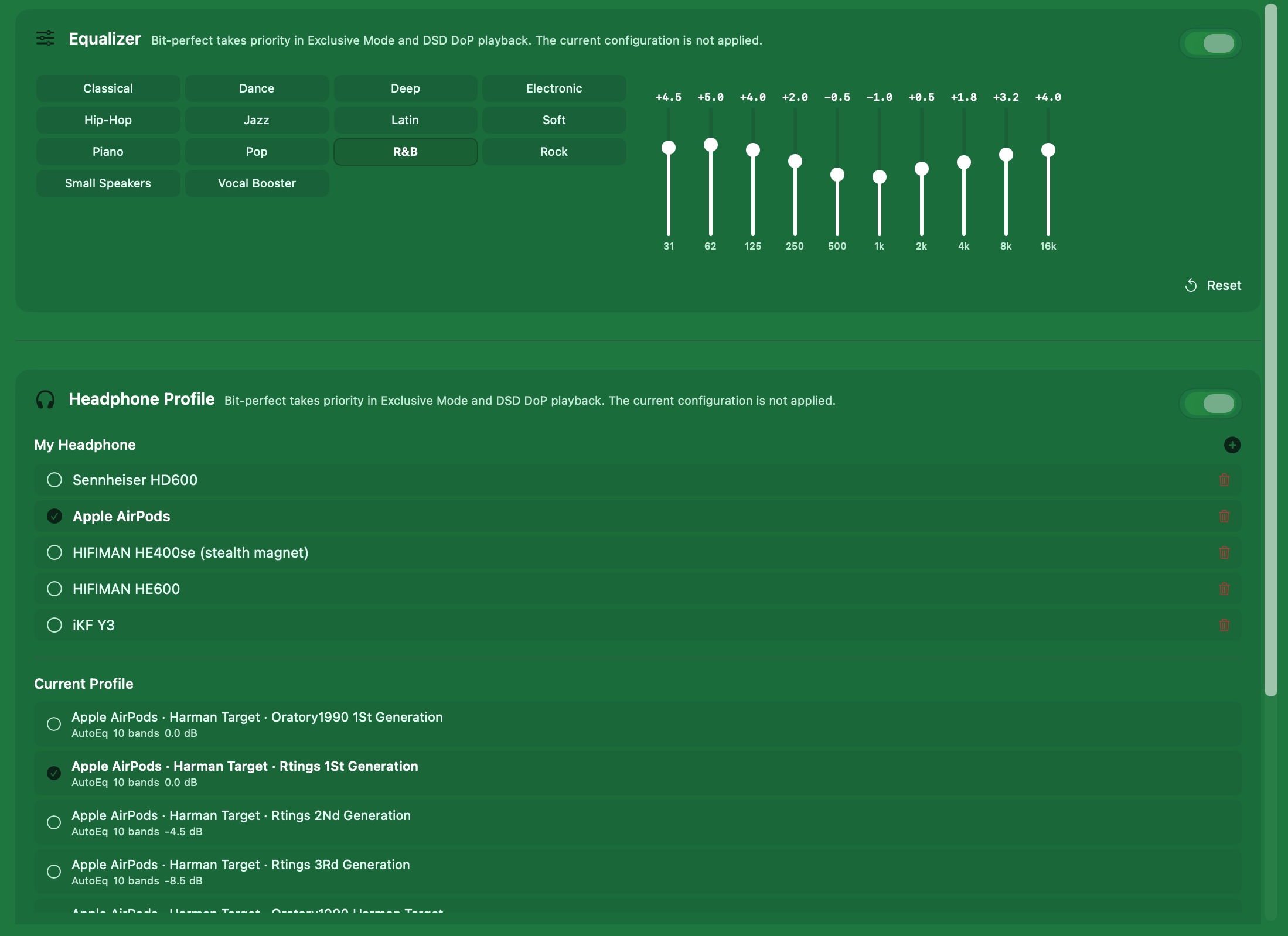
- 10-band EQ with presets — a practical graphic EQ covering the main frequency bands
- Headphone Profiles — model-specific tuning data for consistent, reference-based listening
Upcoming Features
We are actively developing:
- Custom EQ import
- AutoEQ / OPRA compatible curve import
- Higher precision parametric EQ (PEQ)
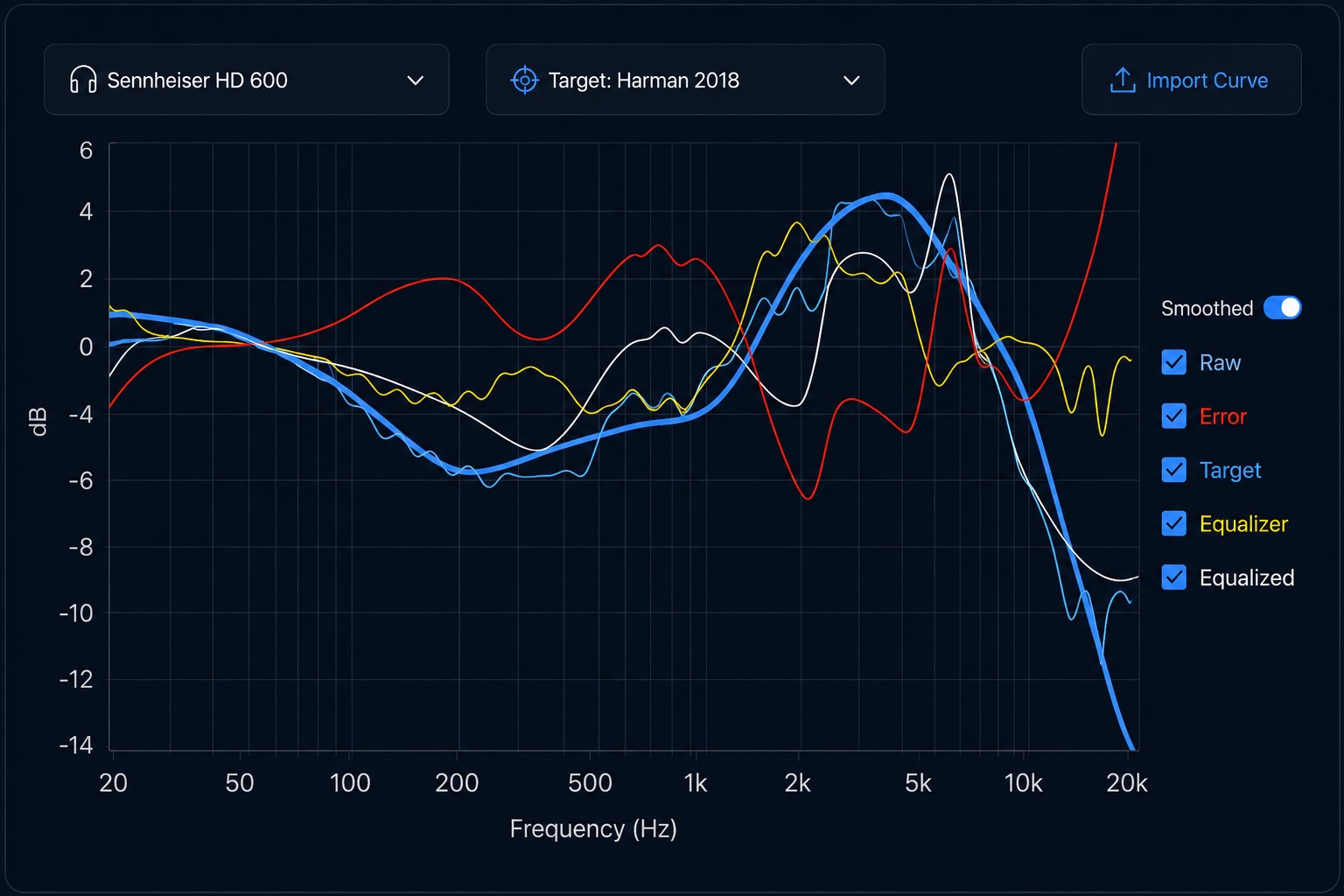
- Visual tuning curve representation
Our goal is simple: provide powerful tuning tools while keeping usability accessible for non-engineers. The aim is that most users can achieve satisfying results using preset profiles without needing to become sound engineers.
Feedback
If you have any thoughts or suggestions about EQ, headphone tuning, or Mossca's related features, we welcome your feedback. It directly influences our future development direction.