Audio Quality Analysis
High-resolution formats do not automatically guarantee high-quality audio.
In practice, the quality of music files varies widely. The same album may exist in multiple versions: original CD masters, vinyl transfers, modern remasters, or even upsampled sources.
For listeners who care about sound quality, the challenge is simple: how do we evaluate the real signal quality of a music file?
Mossca introduces an analysis system designed to examine the actual signal characteristics behind audio files.
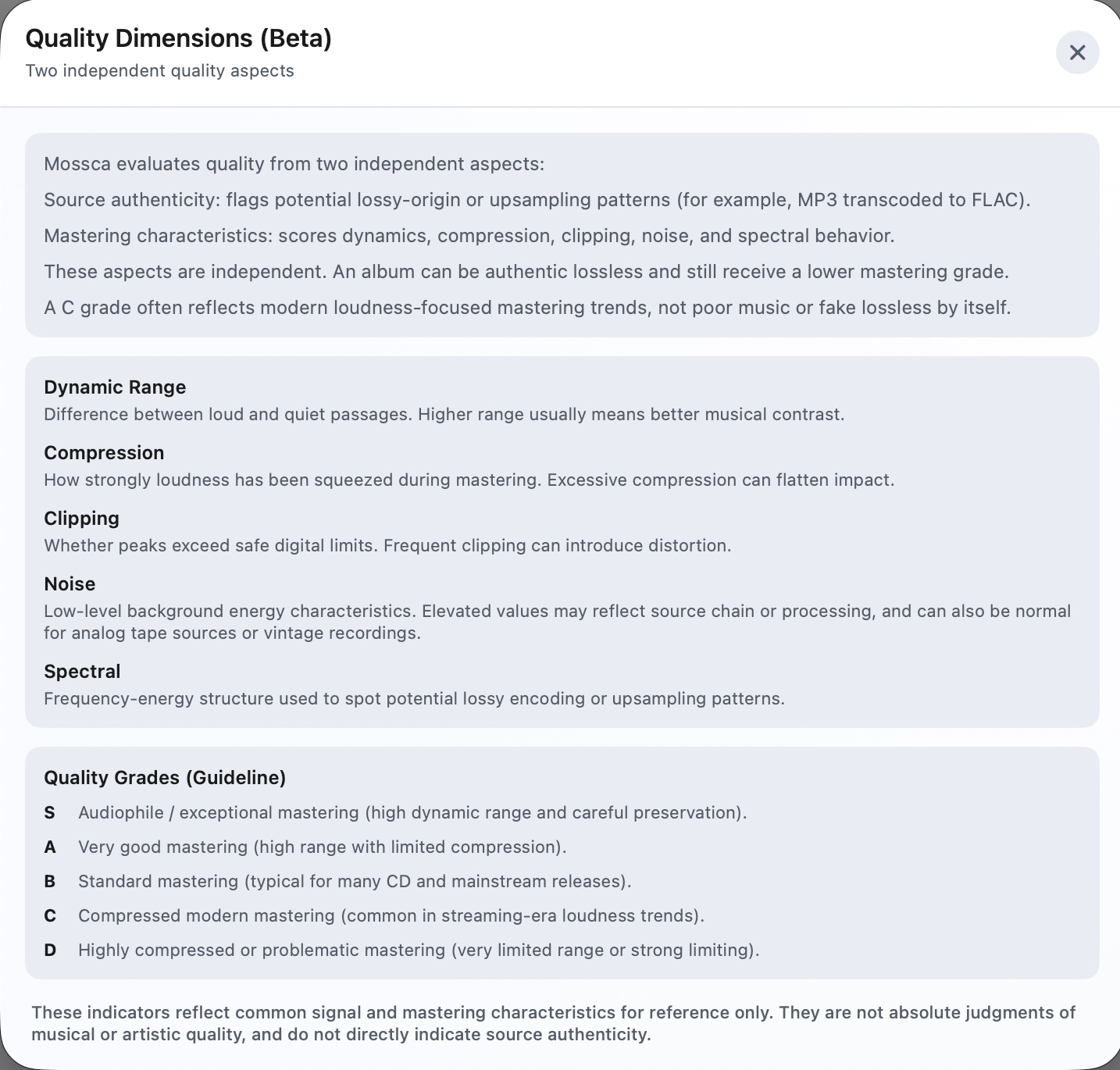
Why Quality Analysis Matters
Lossless formats such as FLAC or WAV only describe how audio is stored. They do not guarantee the original source quality.
A 24-bit / 192 kHz file can still originate from:
- a CD master
- a heavily compressed digital remaster
- an upsampled low-bandwidth source
For collectors of local music libraries, this creates a practical problem: it becomes difficult to understand which versions truly preserve the best audio information.
Mossca's analysis tools aim to make these differences visible through measurable signal characteristics.
How Mossca Evaluates Audio
Mossca analyzes audio using several complementary signal dimensions. Each dimension reflects a different aspect of the recording and mastering chain.
The goal is not to judge music aesthetically, but to describe observable signal properties.
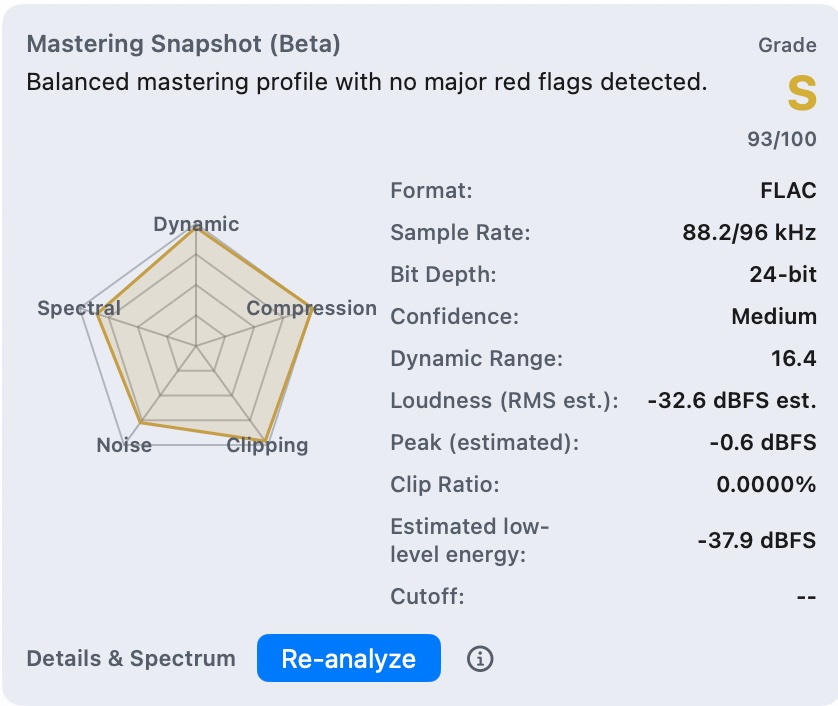
Spectral Structure
Spectral analysis estimates the effective bandwidth of the signal.
This helps detect situations such as:
- genuine high-resolution recordings with extended bandwidth
- CD-limited sources (around 22 kHz bandwidth)
- possible upsampled files with restricted frequency energy
This dimension helps reveal whether a high sample rate file actually contains high-frequency information.
Dynamic Behavior
Dynamic range reflects the difference between quiet and loud parts of a recording.
Higher dynamic range usually indicates:
- less aggressive compression
- more preserved recording dynamics
Lower dynamic range can suggest:
- loudness-oriented mastering
- heavy dynamic compression
This dimension describes the dynamic character of the master rather than the musical content.
Compression Profile
Compression analysis estimates how strongly the signal has been dynamically limited.
Highly compressed masters often show:
- reduced dynamic contrast
- consistent loudness levels across the track
Moderate compression is common in modern digital releases, but extreme compression can reduce perceived clarity and depth.
Clipping Detection
Clipping detection checks whether the signal contains peaks exceeding the digital ceiling.
Frequent clipping may indicate:
- overly aggressive mastering
- digital distortion risks
Mossca estimates clipping probability and peak behavior across the track.
Noise Characteristics
Noise floor analysis evaluates low-level signal energy.
In some cases this can reveal characteristics of the recording chain, such as:
- analog tape noise
- vinyl transfer noise
- digital noise shaping patterns
These characteristics can help explain the origin of certain recordings.
Interpreting the Analysis
The analysis results are summarized using a radar profile that combines multiple signal dimensions. This provides a quick overview of how a recording behaves across different aspects of the signal.
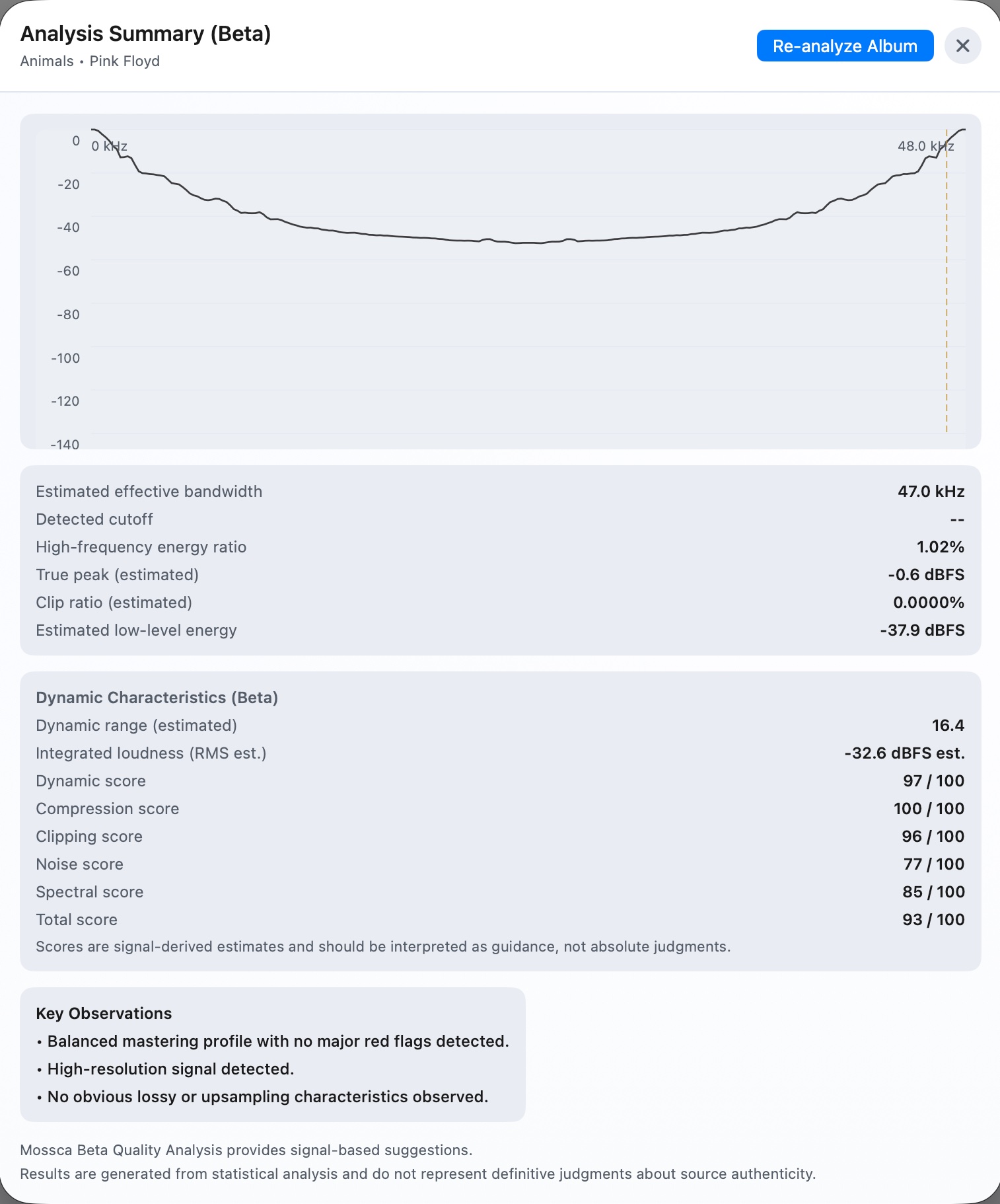
Different types of recordings often produce recognizable patterns:
Analog or high-resolution masters
- extended bandwidth
- higher dynamic range
- stable spectral structure
Modern compressed digital masters
- limited bandwidth (CD range)
- moderate to strong compression
- consistent spectral behavior
Upsampled or pseudo Hi-Res files
- high sample rate but restricted bandwidth
- unusual spectral patterns
- inconsistent signal characteristics
These patterns help listeners understand how different releases may differ technically.
In Mossca
Mossca integrates this analysis directly into the listening workflow.
Users can analyze individual albums in the album page, and also view global library snapshots in Mossca Radar.
- radar summaries of signal characteristics
- estimated bandwidth and dynamic properties
- signal observations derived from the analysis
This provides an additional perspective for users who maintain carefully curated local music libraries.